Introduction
Strata living in New South Wales relies on the proper maintenance and repair of common property to protect property values, ensure safety, and support harmonious communities. When strata buildings fall into disrepair, owners and residents can face significant financial, legal, and personal impacts.
Understanding your rights as a strata lot owner and the strict obligations of the owners corporation is essential for anyone involved in a strata scheme. This guide explains the key responsibilities, legal protections, and practical steps available to address strata disrepair and uphold the standards required by NSW law.
Interactive Tool: Check Who Is Responsible for Strata Repairs & Compensation
Strata Disrepair Liability Checker
Determine if your Owners Corporation is legally responsible for repairs and if you are entitled to compensation for damages.
Under Section 106 of the Strata Schemes Management Act 2015 (NSW), the Owners Corporation has a strict and compulsory duty to maintain common property. Since they have failed to act within two months of notification, you may be entitled to apply to NCAT for orders compelling the work and claim compensation for reasonably foreseeable losses, such as loss of rent or damage to your internal property.
While the duty to repair is strict, Section 106(3) of the Strata Schemes Management Act 2015 (NSW) allows an Owners Corporation to pass a Special Resolution or a By-law to transfer responsibility, as demonstrated in Sorbara v The Owners – Strata Plan 75666 [2021] NSWCATAP 369. You should have your scheme’s by-laws reviewed to confirm if the liability has been legally shifted to you.
If the item is Lot Property (e.g., internal carpet or paint), the repair is typically your responsibility. However, if the damage was caused by a failure of common property (such as a leaking roof or shared pipe), you may still be able to recover damages under Section 106(5) of the Strata Schemes Management Act 2015 (NSW), provided you have taken reasonable steps to mitigate your loss.
The Owners Corporation has an immediate duty to repair, but a legal ‘failure to act’ is often established after two months. During this time, you must take reasonable steps to mitigate your loss (e.g., moving furniture away from leaks) as required by the principle in Smith v Owners – Strata Plan No. 3004. Failure to mitigate can significantly reduce your potential compensation.
Understanding the Strata Owners Corporation’s Duty to Repair
The Strict Obligation to Maintain & Repair Common Property
Under Section 106 of the Strata Schemes Management Act 2015 (NSW), an Owners Corporation has a strict and compulsory duty to properly maintain and keep the common property in a state of good and serviceable repair, an area where seeking legal advice for an owners corporation is critical. This legal responsibility is not optional; the obligation is immediate, and the Owners Corporation cannot simply elect not to perform necessary maintenance.
This duty extends beyond simple repairs. The Owners Corporation must also:
- Renew or replace any fixtures or fittings that are part of the common property as needed
- Understand that the courts have interpreted this as a strict duty, meaning that practical challenges like finding contractors or raising funds are not considered lawful excuses for delaying essential work
Distinguishing Between Repairs & Improvements
A key aspect of the Owners Corporation’s duty is that it is focused on repair and maintenance, not on upgrading or improving the common property, which often leads to the question of does your strata scheme need to repair or upgrade. For example, the Owners Corporation is obligated to fix a broken common area gate, but it is not required to replace it with a more advanced, modern one.
However, the line between a repair and an improvement can sometimes be unclear. Consider a situation where a roof is significantly dilapidated. While it may technically still be functional, its condition detracts from the building’s overall appearance.
In such cases:
- Replacing the roof entirely could be considered “repair and maintenance” rather than an improvement, as simple repairs would no longer be the most appropriate option
- Each situation must be assessed on a case-by-case basis to determine whether the work constitutes repair or improvement
Speak to a Lawyer Today.
We respond within 24 hours.
Identifying Common Property in Your Strata Scheme
Defining Common Property vs Lot Property
Understanding the boundaries of your property is essential in a strata scheme, as the owners corporation is only obligated to repair common property.
Conversely, a lot owner typically owns the airspace within their unit, while the physical structure often remains common property according to the strata plan.
To clarify this distinction, consider the following examples:
- Ceilings: The boundaries of a lot are set out in the strata plan. Moreover, under the Strata Schemes Development Act 2015 (NSW), a lot’s horizontal boundary is usually the under-surface of the ceiling. As a result, the structural ceiling itself is common property, making its maintenance the responsibility of the owners corporation.
- Boundary Windows: Windows and glass on the boundary of a lot generally fall under common property. However, you should check for any specific notations on the strata plan or by-laws, as these documents—often requiring expert review from strata by-law lawyers—may override the general rule.
- Original Waterproofing Membranes: If your bathroom remains unaltered since construction, the owners corporation usually covers the original waterproofing membrane, unless specific notations on the strata plan or relevant by-laws state otherwise.
Visual Diagram of Common Property vs Lot Property
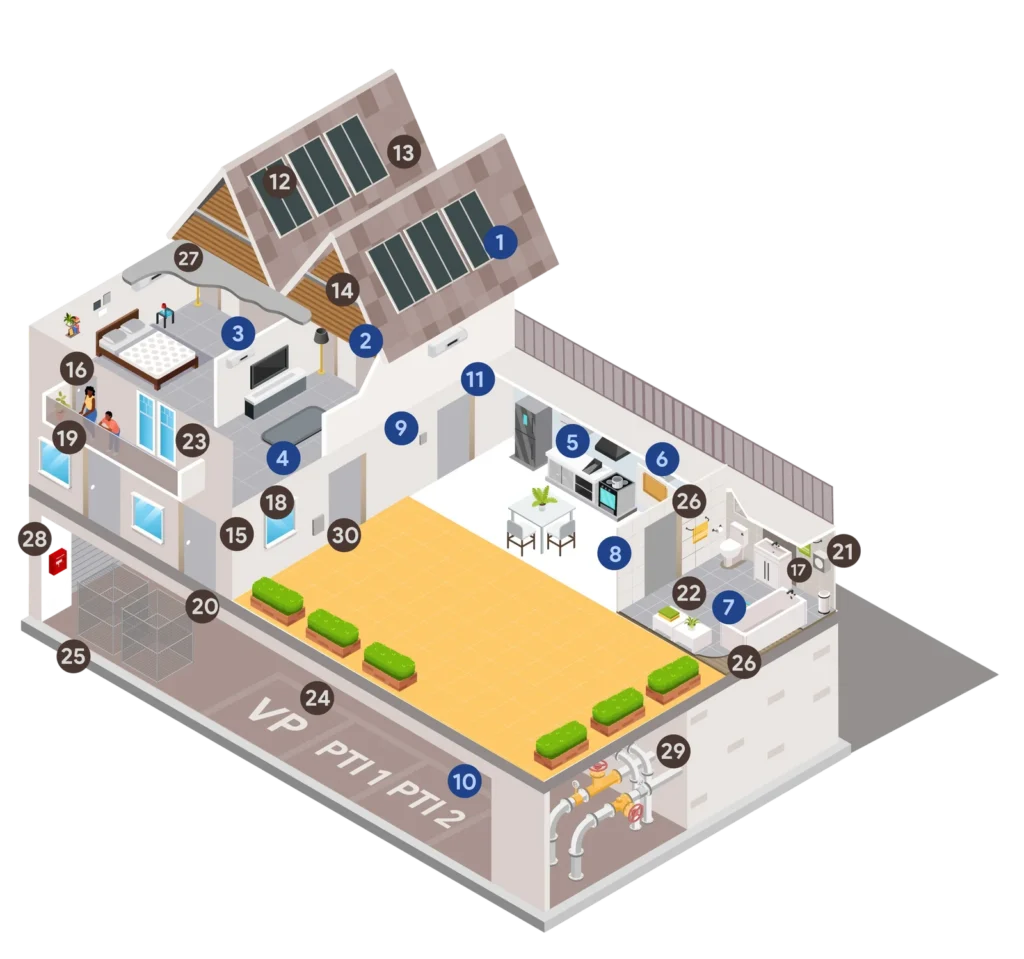
| Private (Lot) Property | Common Property |
| 1. Solar panels installed by lot owner with approval | 12. Common property solar panels |
| 2. Internal walls (not shown on strata plan) | 13. Roof tiling |
| 3. Split-system air-conditioning internal unit and external unit, with approval | 14. Voids enclosing shared plumbing and wires |
| 4. Carpet | 15. External doors |
| 5. Kitchen cupboards and appliances | 16. Balcony doors |
| 6. Curtains and blinds | 17. Tiles and waterproof membrane on the boundary walls |
| 7. Bath, basin, toilet and plumbing above upper surface of the floor | 18. External windows |
| 8. Tiles and waterproof membranes on internal walls (not shown on strata plan) | 19. External balustrades |
| 9. Light fittings, light switches and powerpoints | 20. Slab |
| 10. Lot car parking spaces, above surface | 21. Penetrations for ventilation |
| 11. Internal doors (not shown on strata plan) | 22. Original floor tiles, including floor tiles in the shower |
| 23. Upper and lower boundary of balconies, as shown on strata plan | |
| 24. Visitor car parking spaces | |
| 25. Original common storage cages, if shown on solid thick linespaces | |
| 26. Original waterproofing below floor tiles | |
| 27. Ceiling | |
| 28. Fire alarms | |
| 29. Plumbing outside premises or shared plumbing with other lots | |
| 30. Wiring outside premises or shared wiring with other lots |
Get legal advice you can rely on.
Contact us today.
When a Strata Owners Corporation Can Avoid Repairs
Deferring Repairs When a Lot Owner Is at Fault
An owners corporation may be able to defer its obligation to repair common property if the damage was caused by a specific lot owner. This exception only applies when the owners corporation is actively taking steps to recover the repair costs from the responsible owner. However, this deferral is not permitted if the damage poses any safety risks.
For example, if an owner damages foyer tiles while moving furniture, the owners corporation should:
- Begin the process of pursuing the responsible owner for the cost of the repairs.
- Formally note at a meeting that this action is underway, and as a result, its own obligation to repair is being deferred.
- Be prepared to undertake the repairs itself if the action to recover costs from the lot owner is unsuccessful.
Exemptions Through a Special Resolution
Under Section 106(3) of the Strata Schemes Management Act 2015 (NSW), an owners corporation can legally decide not to repair an item of common property. To do this, it must pass a special resolution at a general meeting, which requires a higher level of agreement among owners.
This exemption is only valid if two specific criteria are met:
- The owners corporation determines that it is “inappropriate” to maintain, repair, or replace the item in question.
- The decision will not negatively affect the safety of any building or common property, nor will it detract from the appearance of any property in the strata scheme.
Once a valid special resolution is passed, the owners corporation is relieved of its strict duty to repair that particular item.
Transferring Responsibility via a Strata By-Law
The responsibility for maintaining and repairing common property can be legally transferred from the owners corporation to an individual lot owner through a specific by-law. This is often done for areas of common property that an owner has been granted exclusive use of, such as a courtyard or a terrace.
These common property rights by-laws must state who is responsible for the upkeep of the area. If the by-law makes the lot owner responsible, it effectively discharges the owners corporation from its duty to repair that part of the common property under the Strata Schemes Management Act 2015.
The case of Sorbara v The Owners – Strata Plan 75666 [2021] NSWCATAP 369 highlighted this, where a by-law made a lot owner responsible for repairing a leaking roof structure over their exclusive-use terrace.
Speak to a Lawyer Today.
We respond within 24 hours.
Your Rights as a Strata Lot Owner When Repairs Are Neglected
How to Compel Your Strata Owners Corporation to Act
If you believe the owners corporation is failing in its duty to repair common property, the first practical step is to raise the issue directly with the strata committee or at a general meeting. This approach can often lead to a sensible discussion and a resolution without further conflict.
However, if discussions do not resolve the issue, you can escalate the matter through formal channels. The next step is to apply for mediation through NSW Fair Trading. Should mediation fail or if the owners corporation refuses to participate, you can then apply to the NSW Civil and Administrative Tribunal (NCAT) for orders compelling the owners corporation to perform the necessary work.
The owners corporation is considered to have failed its duty if it does not take action within two months of being notified, which allows an owner to begin this process.
When applying to NCAT, an owner will generally need to establish:
- That the item in question is common property.
- That it requires repair or maintenance.
- The specific repair or maintenance that is needed.
- That the owners corporation has no valid reason for avoiding the work.
Claiming Compensation for Damages & Loss
In addition to seeking orders for repairs, a lot owner can claim financial compensation for losses suffered due to the owners corporation’s failure to maintain common property. Under Section 106(5) of the Strata Schemes Management Act 2015 (NSW), an owner may recover damages for any reasonably foreseeable loss that results from this breach of duty.
For example:
- If a leaking common property roof causes water damage inside a unit, the owner could seek compensation for the cost of repairing damaged carpets and plasterboard.
- If the damage makes the unit uninhabitable, the owner may be able to claim for loss of rent.
These claims can be made in the NSW Civil and Administrative Tribunal (NCAT). It is important to note that an owner must bring a claim for damages within two years of becoming aware of the loss.
Understanding Your Duty to Mitigate Loss
While you have the right to seek compensation, you also have a legal duty to mitigate your loss. This means you cannot allow damage to accumulate without taking reasonable steps to minimise it. The courts have confirmed that the principle of mitigation applies to claims for damages under the Strata Schemes Management Act 2015 (NSW).
Consider a scenario where a known leak is damaging your carpet. You are expected to take reasonable actions, such as:
- Moving furniture to prevent further damage.
- Placing buckets to catch water, rather than simply letting the damage worsen.
In the case of Smith v Owners – Strata Plan No. 3004, the court found that an owner’s choice to leave their unit vacant for an extended period was not a foreseeable consequence of the owners corporation’s breach. As a result, the recoverable damages for lost rent were significantly reduced, highlighting that owners must act reasonably to limit their own losses.
Get legal advice you can rely on.
Contact us today.
The Consequences of Ineffective Strata Maintenance
Decline in Property Value & Financial Strain
Poor strata management, particularly the deferral of essential maintenance, can significantly undermine property values. When buildings fall into disrepair, visible deterioration deters potential buyers who fear future costly repairs.
Moreover, ineffective financial management within a strata scheme often leaves insufficient funds for maintenance and upgrades. This shortfall can lead to:
- Decline in the building’s overall condition, eroding buyer confidence.
- Unexpected special levies imposed on owners, causing financial strain.
Together, these outcomes place considerable pressure on current owners and discourage prospective purchasers.
Reputational Damage & Insurance Difficulties
A building’s reputation plays a crucial role in its market appeal. In particular, a strata scheme known for:
- Mismanagement – shaking investor and buyer trust.
- Ongoing maintenance issues – signalling neglect and future costs.
- Resident disputes – reflecting poorly on community harmony.
is less likely to attract quality buyers or tenants, resulting in lower property values and reduced market interest.
Furthermore, schemes with building defects caused by inadequate upkeep may struggle to secure mandatory building insurance. This often results in:
- Difficulty securing mandatory building insurance, which can delay urgent repairs.
- Rising insurance premiums, exposing owners to higher costs that could have been avoided with proactive maintenance.
Speak to a Lawyer Today.
We respond within 24 hours.
Conclusion
In NSW, an owners corporation has a strict legal duty under the Strata Schemes Management Act 2015 (NSW) to repair and maintain common property, and lot owners have clear rights to seek orders and compensation when this obligation is neglected. Understanding the distinction between common and lot property, the limited exceptions to this duty, and your own responsibility to mitigate loss is crucial for protecting your investment and ensuring your building is properly maintained.
If you are dealing with strata disrepair issues and require guidance, contact the strata dispute lawyers at PBL Law Group for trusted legal expertise. Our specialised strata law firm in Sydney can help you navigate your rights and the owners corporation’s responsibilities to achieve a fair and timely resolution.
Frequently Asked Questions